AI Executive Summary
"This article analyzes the strategic shift from binary land use to integrated agrivoltaic systems that mitigate hydrologic extremes. It highlights a global blueprint for resource resilience, merging energy generation with food security across water-stressed regions."
The historical conflict between food security and energy transition has reached a breaking point. For decades, the logic was binary: a parcel of land was either a field for crops or a site for solar arrays. This zero-sum game is now being dismantled. We are seeing a shift toward the integrated productive landscape, where the canopy of solar panels serves as a protective shield for the soil beneath. This is not merely a technical upgrade; it is a systemic pivot toward resource efficiency that is gaining urgent traction across the most water-stressed corridors of the planet.
The Italian Blueprint for Water Resilience
In Italy, the marriage of agriculture and renewable energy is moving from niche pilots to scalable industrial applications. The agrivoltaic vineyards in Sarzana and the citrus and olive groves managed by the Le Greenhouse Consortium in Calabria demonstrate the immediate 'so what' of this trend. The Consortium is currently expanding its sustainable agrivoltaic footprint by an additional 15 MW across approximately 25 hectares. This is not just about adding power to the grid; it is about creating a microclimate that fundamentally alters the plant's relationship with the sun.
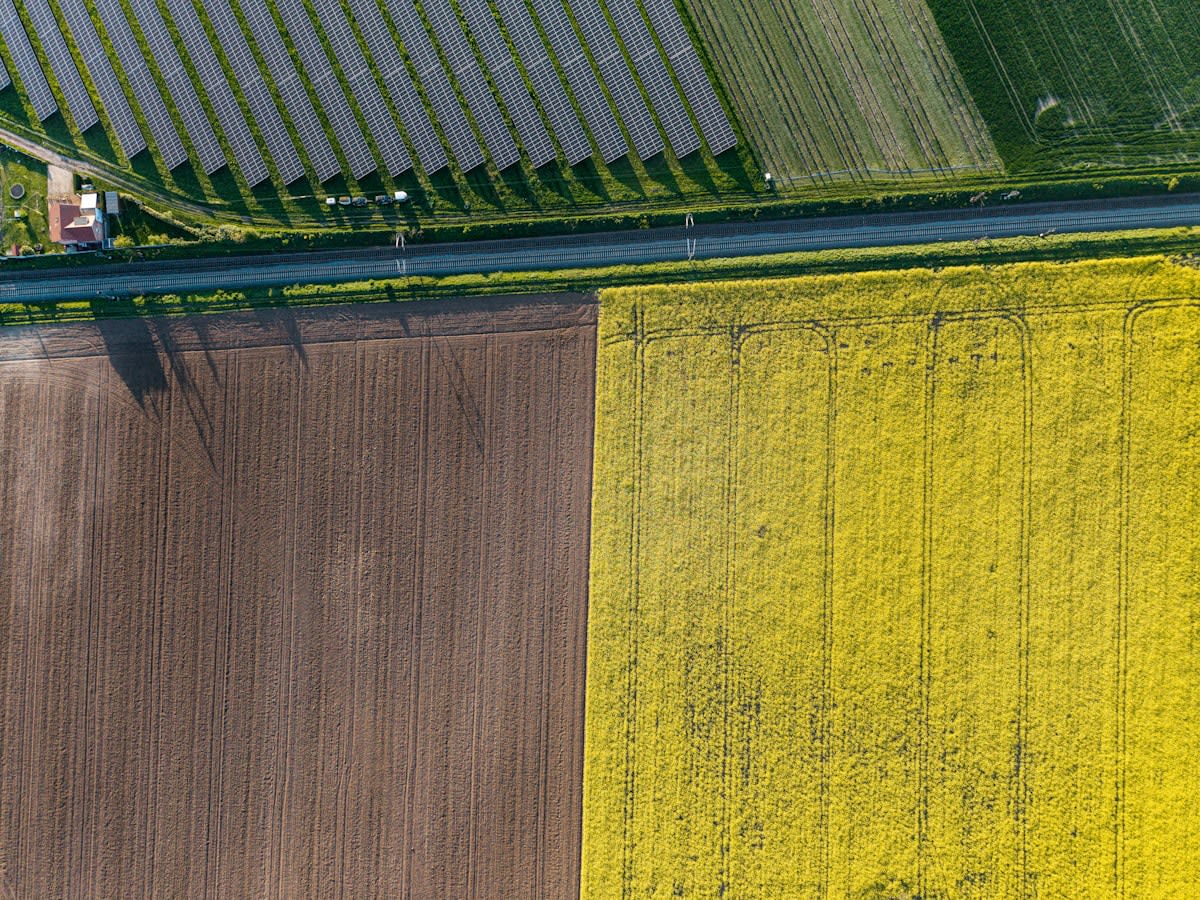
The critical technical victory here is the significant reduction in soil evapotranspiration. By limiting the total amount of water that passes from the soil and plants into the atmosphere as vapour, these systems directly lower the crop's water requirements. For a farmer, this means the difference between a failed harvest during a heatwave and a resilient yield. The implementation by i-pergola srl, a benefit corporation funded under the National Recovery and Resilience Plan (PNRR), proves that when state funding aligns with ecological logic, the result is a reduction in resource volatility.
The Evapotranspiration Edge
The reduction in evapotranspiration is the hidden engine of agrivoltaics. It transforms a solar array from a land-occupying obstacle into a water-saving tool.
From Ornamental Green to Productive Infrastructure
While Italy refines the technical canopy, the Gulf Cooperation Council (GCC) is rethinking the very definition of urban and rural planning. In Saudi Arabia, the UAE, Qatar, Oman, Bahrain, and Kuwait, a new generation of masterplans is treating agriculture and water reuse as the organizing logic of entire districts. The Journey Through Time Masterplan in AlUla, Saudi Arabia, stands as a primary example of this shift, moving away from 'ornamental green'—which consumes vast amounts of water for aesthetics—toward productive landscapes that actually contribute to food security.
The operational backbone of this transition is Treated Sewage Effluent (TSE). Across the GCC, TSE has become the dominant non-potable water source for landscapes, turning wastewater into a strategic asset. In Kuwait, the South Saad Al-Abdullah City project is embedding treated-water and drainage infrastructure at a new-city scale, while the Hamala Agricultural Oasis in Bahrain, a collaboration between Edamah and Badia Farms, is integrating explicit hydroponic urban farming into a 5-hectare redevelopment. This represents a total departure from the previous decade's approach to desert greening.
The Digital and Financial Catalyst
The scalability of these systems depends on precision. This July, the Food and Agriculture Organization of the United Nations (FAO) launched CropSuit, a web-based application designed to help farmers identify the exact crops best suited for specific parcels of land. By combining soil information, climate data, topography, and land cover, CropSuit removes the guesswork from planting. This tool, part of the SoilFER programme funded by Japan and the United States, is essential for regions in Africa and Central America—and by extension, Central Asia—where soil degradation makes traditional farming a gamble.
Parallel to the digital tools is a shift in how the energy itself is monetized. In Chile, Grenergy has introduced a reverse energy auction model to optimize the sale of 1.5 TWh per year of energy. This model is sophisticated: it integrates 540 GWh of solar photovoltaic generation with 960 GWh of battery-stored energy specifically for nighttime injection. This ensures that the energy harvest is not just abundant during the day, but reliable 24/7, creating a financial stability that makes the initial investment in agrivoltaic infrastructure far more attractive to private capital.
Central Asian Diversification: The Strategic Pivot
Why is this global trend critical for Central Asia? The region is currently witnessing a broader pattern of diversification. Take Kazakh gold miner Solidcore Resources, which recently signed its first exploration venture outside Kazakhstan to develop the Khabiyat copper-gold project in Oman. This move signals a strategic realization among Central Asian industrial players: diversification is the only hedge against regional volatility. Just as Solidcore is diversifying its mineral portfolio across borders, the region's agricultural sector must diversify its utility.
The 'bet' Central Asia is making is a convergence of these global lessons. By adopting the agrivoltaic water-saving techniques seen in Italy, the productive landscape masterplanning of the GCC, and the precision mapping of the FAO's CropSuit, the region can transform its farmland from a liability into a dual-revenue asset. The boundary between energy production and food cultivation is narrowing, rendering the old 'dual-use' terminology obsolete. We are moving toward a 'total-defense' realism regarding resource management, where every square meter of land must perform multiple functions to survive.
"The space between civilian and military capability is narrower than our language has allowed... the countries making serious preparations for this strategic moment are the ones that have already stopped pretending otherwise."— SpaceNews Analysis on Dual-Use Logic
Applying this logic to the environment, the 'pretending' was the belief that we could separate the energy grid from the food chain. The current delta—the difference between 2025 and 2026—is the realization that the solar panel is not an intruder on the farm, but a vital piece of agricultural infrastructure. When you combine Chile's storage auctions, Italy's evapotranspiration data, and the GCC's TSE water networks, the result is a blueprint for a resilient, multi-functional landscape that can withstand the volatility of the coming decade.