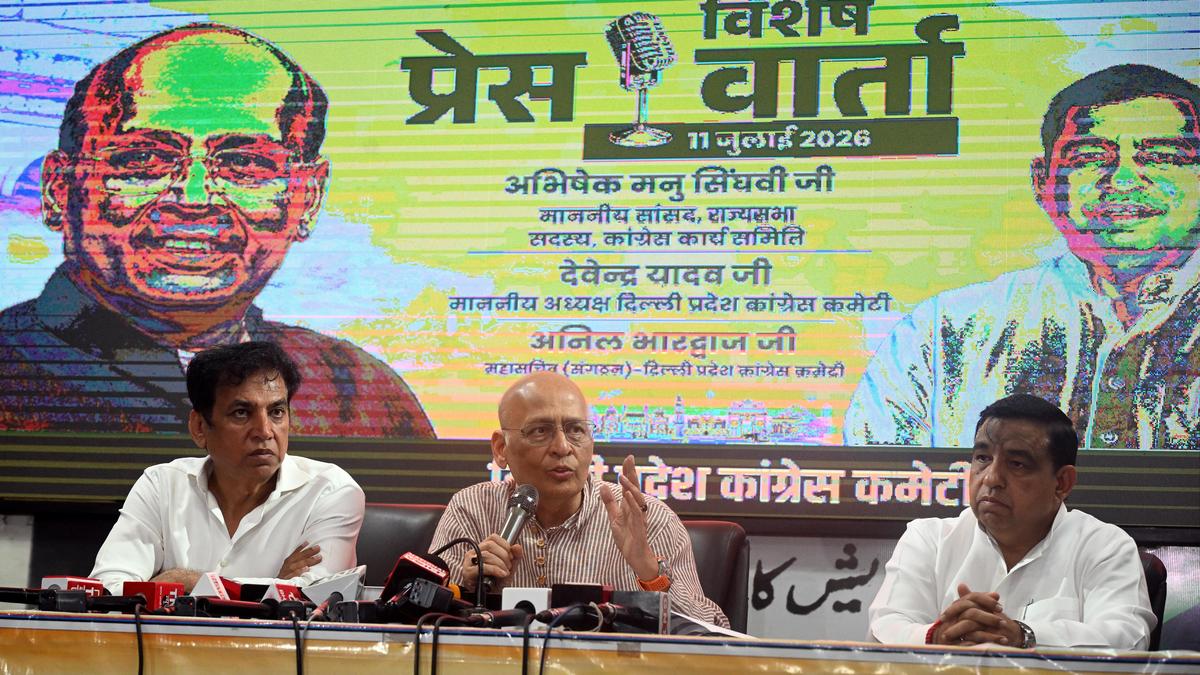
Congress steps up Ram Temple campaign, asks Modi to answer for alleged donation theft
Source Entity
India Latest News: Top National Headlines Today & Breaking News | The Hindu
Intelligence Synthesis
AI-Generated Core Insights
The Indian National Congress has launched a nationwide campaign consisting of 26 press conferences, demanding that Prime Minister Narendra Modi provide answers regarding allegations of donation theft associated with the Ram Temple project.
Political Accountability and the Ram Temple: An Analysis of Congress's New Offensive
The Indian National Congress (INC) has strategically escalated its political confrontation with the ruling Bharatiya Janata Party (BJP) by launching a coordinated nationwide campaign centered on the Ram Temple in Ayodhya. By organizing 26 simultaneous press conferences across various states, the Congress party is attempting to nationalize a specific grievance: the alleged misappropriation or 'theft' of donations intended for the temple's construction. This move represents a calculated shift in the opposition's strategy, moving from a critique of the temple's ideological foundations to a critique of the financial transparency and governance surrounding its execution.
The Strategy of Saturation and Public Narrative
The decision to hold 26 press conferences across the country is a classic 'saturation' tactic designed to ensure that the narrative reaches diverse linguistic and regional demographics. By decentralizing the announcement, the Congress party aims to prevent the story from being contained within the Delhi-centric political bubble. The core of their argument is that Prime Minister Narendra Modi, having positioned himself as the primary champion and political face of the temple's realization, must now accept the burden of accountability. By framing the Prime Minister as 'directly answerable to the nation,' the INC is attempting to link the personal prestige of the PM to the alleged financial irregularities, thereby making the issue a matter of national integrity rather than a mere administrative dispute.
Financial Transparency as a Political Lever
Historically, religious donations in India carry immense emotional and spiritual weight. Allegations of 'donation theft' are particularly potent because they target the trust of the common devotee. By shifting the discourse toward financial audits and the transparency of the temple trust, Congress is attempting to pivot the conversation away from the BJP's strong hold on religious sentiment. This approach seeks to create a dichotomy between the 'purity' of the faith and the 'corruption' of the political machinery managing it. If the opposition can successfully plant seeds of doubt regarding the handling of public funds, they may be able to alienate a segment of the BJP's core electoral base that prioritizes both faith and honest governance.
Historical Context and Political Ownership
The Ram Temple project has been the central pillar of the BJP's political identity for decades, evolving from the Ram Janmabhoomi movement of the 1980s and 90s to its eventual realization via a Supreme Court mandate. Prime Minister Modi's high-profile involvement in the temple's groundbreaking and inauguration ceremonies cemented his image as the deliverer of a long-held ideological promise. The Congress party is now leveraging this 'political ownership' against him. The logic is simple: if the victory of the temple's construction is claimed by the leadership, then any failure—including alleged financial malpractice—must also be owned by that same leadership.
Broader Implications for the Electoral Landscape
This campaign signals a broader trend in Indian politics where the opposition is seeking new avenues to challenge the BJP's narrative dominance. By focusing on the 'theft' of donations, Congress is trying to bridge the gap between ideological opposition and the populist appeal of anti-corruption rhetoric. This could force the government into a defensive posture, requiring them to release detailed financial disclosures or audits that might otherwise have remained private. The ability of the Congress to sustain this momentum across 26 different regions will be a litmus test for their organizational capacity to coordinate a nationwide attack on a single, high-stakes issue.
Future Trends and Predictive Outlook
Looking forward, it is likely that the BJP will dismiss these allegations as politically motivated fabrications aimed at hurting religious sentiments. However, if the Congress party can produce specific evidence or whistleblowers regarding the donation trail, this could evolve into a significant legal and political scandal. We can expect a cycle of counter-accusations, with the ruling party potentially highlighting past financial irregularities within the Congress party to deflect attention. Ultimately, this clash underscores the reality that in contemporary Indian politics, even the most sacred projects are subject to the rigorous and often aggressive scrutiny of electoral competition.
Summary
In essence, the Congress party's campaign is a sophisticated attempt to turn the BJP's greatest ideological achievement into a political liability. By focusing on the alleged theft of donations and demanding direct accountability from Prime Minister Modi, the INC is attempting to shift the national conversation from faith to finance, challenging the government on the grounds of transparency and public trust.
Verification Required?