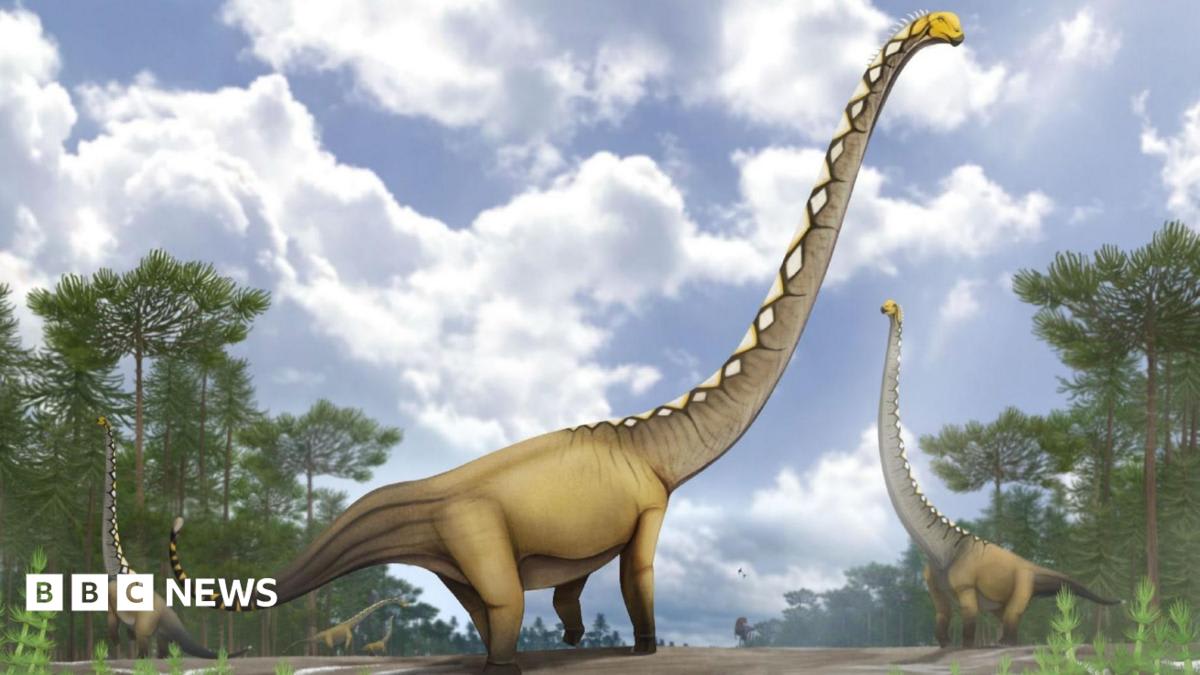
New dinosaur species with neck as long as cricket pitch discovered in Thailand
Source Entity
BBC News
Intelligence Synthesis
AI-Generated Core Insights
Paleontologists have identified a new plant-eating dinosaur species in Thailand, named Uragasaurus kalasinensis, which dates back approximately 150 million years and is distinguished by a neck roughly the length of a cricket pitch.
A Giant Awakens: The Discovery of Uragasaurus kalasinensis
The scientific community has been galvanized by the discovery of a new dinosaur species in Thailand, Uragasaurus kalasinensis. This herbivorous giant, which roamed the Earth approximately 150 million years ago, is most notable for its extraordinary anatomical proportions—specifically a neck described as being as long as a cricket pitch (roughly 20 meters). This discovery not only adds a new branch to the dinosaur family tree but also provides critical data on the biodiversity of the Late Jurassic and Early Cretaceous periods in Southeast Asia.
Anatomical Marvels and Survival Strategies
The most striking feature of Uragasaurus kalasinensis is undoubtedly its elongated neck. From an evolutionary perspective, such a specialization suggests a highly efficient browsing strategy. By possessing a neck of this magnitude, the Uragasaurus could access high-canopy vegetation that was entirely unreachable for other herbivores of its time, effectively eliminating direct competition for food resources. This biological adaptation indicates a niche specialization that allowed the species to thrive in an environment characterized by lush, towering flora. The sheer scale of the creature suggests a massive caloric requirement, pointing toward a sophisticated digestive system capable of processing vast quantities of plant matter.
The Significance of the Kalasin Region
The discovery in Thailand, particularly within the Kalasin province, underscores the region's importance as a paleontological goldmine. The geological formations in this area have historically yielded significant fossils, suggesting that the prehistoric landscape of Thailand was a fertile basin supporting diverse megafauna. The preservation of Uragasaurus kalasinensis suggests a depositional environment—likely a river delta or floodplain—that allowed for the rapid burial of the carcass, protecting the skeletal structure from scavengers and erosion over millions of years. This find reinforces Thailand's position as a key site for understanding dinosaur distribution across the supercontinent of Pangaea as it began to break apart.
Temporal Context: 150 Million Years Ago
Living 150 million years ago places Uragasaurus kalasinensis in a pivotal era of dinosaur evolution. During this time, sauropods—the group of long-necked dinosaurs to which Uragasaurus likely belongs—were reaching their zenith in terms of size and dominance. The presence of such a large herbivore in Southeast Asia suggests that the environmental conditions of the time were globally conducive to gigantism. Analyzing the strata in which these fossils were found allows scientists to reconstruct the climate of the era, which was likely warmer and more humid than today, supporting the massive forests required to sustain such colossal animals.
Broader Evolutionary Implications
This discovery challenges and refines our understanding of sauropod migration and evolution. The existence of Uragasaurus kalasinensis suggests that Southeast Asia was not merely a peripheral zone but a central hub for dinosaur diversification. By comparing the skeletal structure of Uragasaurus with other known sauropods from Africa or North America, paleontologists can trace the migratory paths and evolutionary splits that occurred as land bridges shifted. This helps in mapping how these giants adapted to different regional climates and food sources, providing a clearer picture of the global prehistoric ecosystem.
Future Horizons in Thai Paleontology
Looking forward, the discovery of Uragasaurus kalasinensis is expected to trigger an increase in funding and interest in Thai paleontological expeditions. There is a high probability that more specimens, including those of predators that may have hunted the Uragasaurus, remain undiscovered in the Kalasin region. Future research will likely focus on isotopic analysis of the teeth to determine the exact types of plants the dinosaur consumed and the seasonal migration patterns it may have followed. As technology in CT scanning and molecular paleontology advances, scientists may even unlock deeper secrets regarding the growth rates and social behaviors of this magnificent species.
Conclusion
Uragasaurus kalasinensis stands as a testament to the sheer scale of prehistoric life and the enduring mystery of the natural world. Its discovery in Thailand not only highlights the biological ingenuity of the sauropods but also cements the region's status as a critical archive of Earth's history. Through the study of this long-necked giant, science moves one step closer to understanding the complex interplay between anatomy, environment, and survival that defined the age of dinosaurs.