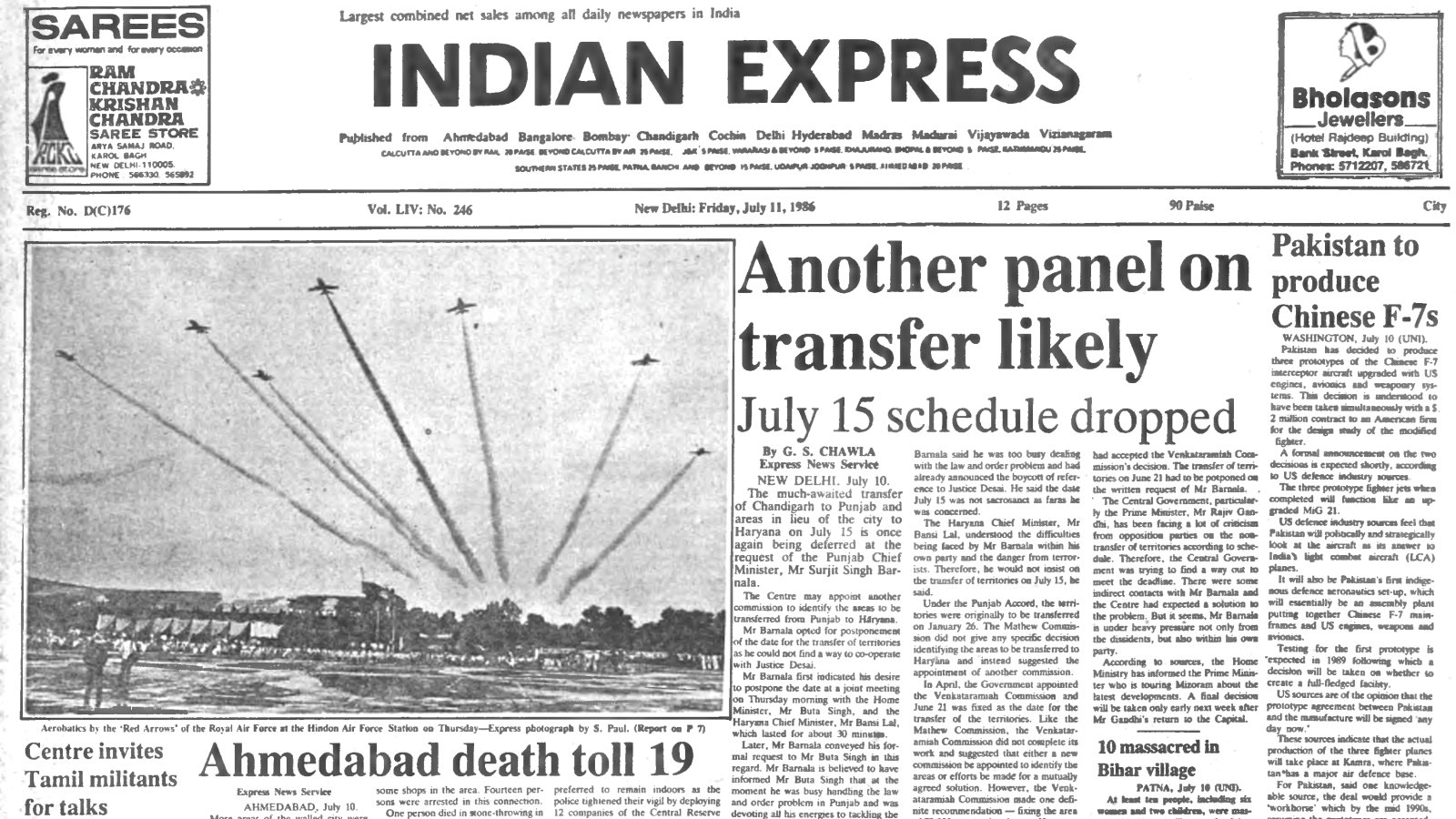
40 years ago, July 11, 1986: Another panel on transfer likely
Source Entity
The Indian Express
Intelligence Synthesis
AI-Generated Core Insights
A retrospective analysis of the July 11, 1986, proposal by the Indian Central Government to appoint a commission to resolve the territorial dispute between Punjab and Haryana regarding the transfer of Chandigarh and compensatory land areas.
The Long-Standing Tug-of-War: Analyzing the 1986 Chandigarh Transfer Proposal
On July 11, 1986, the Indian Central Government considered the appointment of a new commission to identify specific territorial areas to be transferred from Punjab to Haryana. This move was designed as a compensatory mechanism in exchange for the potential transfer of Chandigarh, a city that has remained a flashpoint of political and emotional contention between the two neighboring states for decades. The proposal highlights the Centre's historical struggle to mediate a permanent settlement for the shared capital, reflecting a complex intersection of linguistic identity, administrative logistics, and political leverage.
The Core Conflict: Land in Lieu of City
The essence of the 1986 proposal was the concept of "land in lieu of the city." Because Chandigarh serves as the administrative hub for both Punjab and Haryana, any movement to grant the city exclusively to one state required a balanced trade-off to maintain territorial and economic equilibrium. The proposed panel was tasked with the grueling work of identifying which villages or districts in Punjab would be ceded to Haryana to offset the loss of the city. This process is inherently volatile, as land in these regions is not merely a financial asset but is deeply tied to agrarian identity and ancestral heritage, making any forced transfer a potential catalyst for social unrest.
Historical Context: The Legacy of 1966
To understand the significance of the 1986 panel, one must look back to the Punjab Reorganisation Act of 1966. The state of Punjab was partitioned on linguistic lines to create the Punjabi-speaking state of Punjab and the Hindi-speaking state of Haryana. Chandigarh, designed by Le Corbusier, was designated as a Union Territory to serve as the joint capital. However, this compromise created a permanent state of instability. Punjab has long argued that since the city is geographically located within its borders and serves as its cultural heart, it should be the sole owner. Haryana, conversely, has viewed the city as its primary administrative anchor, leading to the cyclical attempts at mediation seen in the 1986 reports.
Political Implications and Federal Friction
The appointment of such commissions by the "Centre" underscores the delicate balance of Indian federalism. By acting as the arbiter, the Central Government often found itself caught between the demands of regional political parties and the necessity of maintaining national stability. In 1986, these discussions occurred against a backdrop of significant regional turbulence in Punjab, meaning that any perceived bias by the Central Government in the land-transfer process could have been misinterpreted as a political attack, further alienating regional leadership and complicating the peace process.
Socio-Economic Challenges of Territorial Swap
Beyond the high-level political maneuvering, the proposal to transfer areas from Punjab to Haryana posed immense practical challenges. A territorial swap involves shifting the jurisdiction of thousands of citizens, changing their voting districts, and altering the delivery of state-funded subsidies and services. The 1986 panel would have had to navigate the complexities of land records, water rights, and local governance. The failure of many such historical panels to reach a conclusion often stemmed from the fact that the "value" of land in a rural village cannot be easily equated to the administrative and symbolic value of a planned city like Chandigarh.
Conclusion and Future Trajectory
The 1986 effort to resolve the Chandigarh dispute via a transfer commission serves as a case study in the difficulties of resolving post-partition territorial disputes. While the specific panel mentioned in the archives may have been one of many, it represents a recurring pattern of attempted resolution followed by political stalemate. Even in contemporary politics, the demand for Chandigarh to be integrated into Punjab remains a potent campaign issue, proving that the issues the 1986 commission sought to address remain unresolved. The legacy of this dispute continues to influence the relationship between Punjab and Haryana, ensuring that the question of the "shared capital" remains a central theme in North Indian politics.