'Bomb Iran like never before': Trump reveals revenge instructions if he is assassinated
Source Entity
Latest News: Today's Latest News Headlines from India & World | Hindustan Times | Hindustan Times
Intelligence Synthesis
AI-Generated Core Insights
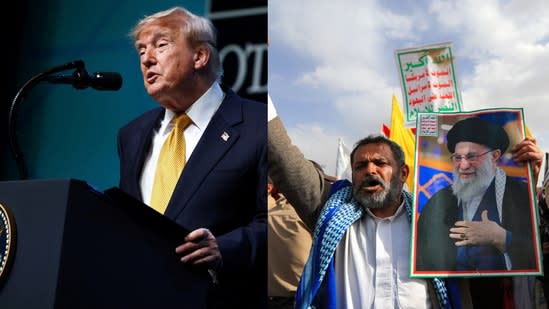
Donald Trump has reportedly issued directives for the United States to launch massive, unprecedented military strikes against Iran in the event that he is assassinated, highlighting the extreme volatility of US-Iran relations.
Escalation and Deterrence: Analyzing Trump's 'Revenge' Directives
In a startling revelation that underscores the volatile nature of current geopolitical tensions, Donald Trump has stated that he has provided specific instructions for the United States to execute "overwhelming military action" against Iran should he be assassinated. This announcement is not merely a statement of personal security but a strategic—and highly controversial—attempt at deterrence. By publicizing a pre-planned, massive military response, Trump is attempting to create a 'dead hand' scenario, where the cost of an attack on his person would be an immediate and catastrophic blow to the Iranian state.
The Doctrine of Overwhelming Response
This approach mirrors the logic of Mutual Assured Destruction (MAD) seen during the Cold War, albeit applied to a non-nuclear, asymmetrical context. By specifying that the response should be "like never before," Trump is signaling a departure from traditional measured retaliation. Historically, U.S. military responses to provocations are determined by the sitting Commander-in-Chief and the National Security Council based on real-time intelligence. The idea of pre-set "revenge instructions" bypasses the usual deliberative process of the U.S. government, suggesting a desire to remove hesitation from the retaliatory chain of command.
Historical Context of US-Iran Hostility
To understand the weight of this statement, one must look at the trajectory of US-Iran relations during Trump's tenure and beyond. The relationship reached a nadir in January 2020 with the U.S. drone strike that killed Iranian General Qasem Soleimani. That event demonstrated Trump's willingness to take high-stakes, unilateral military action against Iranian leadership. By linking his own survival to the fate of Iranian infrastructure or leadership, Trump is extending the "Maximum Pressure" campaign into a personal security guarantee, framing the Iranian government as the primary existential threat to his safety.
Legal and Constitutional Implications
From a constitutional perspective, these instructions raise significant questions regarding the transfer of power and the authority of the executive branch. If a president is assassinated, the presidency immediately passes to the Vice President or the next in line. The legality of a former or deceased leader's "instructions" overriding the strategic judgment of a successor is highly questionable. However, the political pressure to follow through on such a public promise could force a successor's hand, potentially dragging the United States into a full-scale war based on a pre-arranged directive rather than a calculated strategic necessity.
Geopolitical Risks and Regional Stability
The broader implications for the Middle East are profoundly destabilizing. Such rhetoric can be perceived by Tehran not as a deterrent, but as a provocation or a sign of instability within the U.S. leadership. This could inadvertently encourage Iran to accelerate its nuclear program or increase its proxy activities in Iraq, Syria, and Lebanon as a means of creating its own deterrent. The risk of miscalculation is heightened when the threshold for "overwhelming action" is tied to a single individual's life rather than a collective national security breach.
Conclusion: The Intersection of Personal and National Security
Ultimately, Trump's revelation represents a blurring of the line between personal grievance and national security policy. While the stated goal is to prevent an assassination, the method—threatening unprecedented war—increases the overall temperature of global conflict. This strategy relies on the assumption that the adversary is rational and fears a massive strike more than they value the elimination of a political opponent. As tensions continue to simmer, the prospect of pre-planned military escalation remains a dangerous variable in the fragile balance of power in the Persian Gulf.
Verification Required?