AI Executive Summary
"This article analyzes the critical shift from brute-force GPU scaling to energy-efficient probabilistic and biological computing. It highlights the strategic move toward custom silicon and organoid intelligence as the new frontier for AI dominance and geopolitical power."
The Thermodynamics Wall
GPUs are power-hungry. This trajectory is unsustainable. Data centers will likely consume 10% of all U.S. energy by 2030. Such numbers are catastrophic. Thermodynamics dictates the ceiling. We are hitting a wall where adding more chips creates more heat than the cooling systems can remove.
Current AI scaling relies on brute force. Every new parameter requires more wattage and more water. The industry has treated electricity as an infinite resource. This delusion is ending. The physical cost of intelligence is now the primary bottleneck for global AI deployment.
Probabilistic Hardware Breaks the Curve
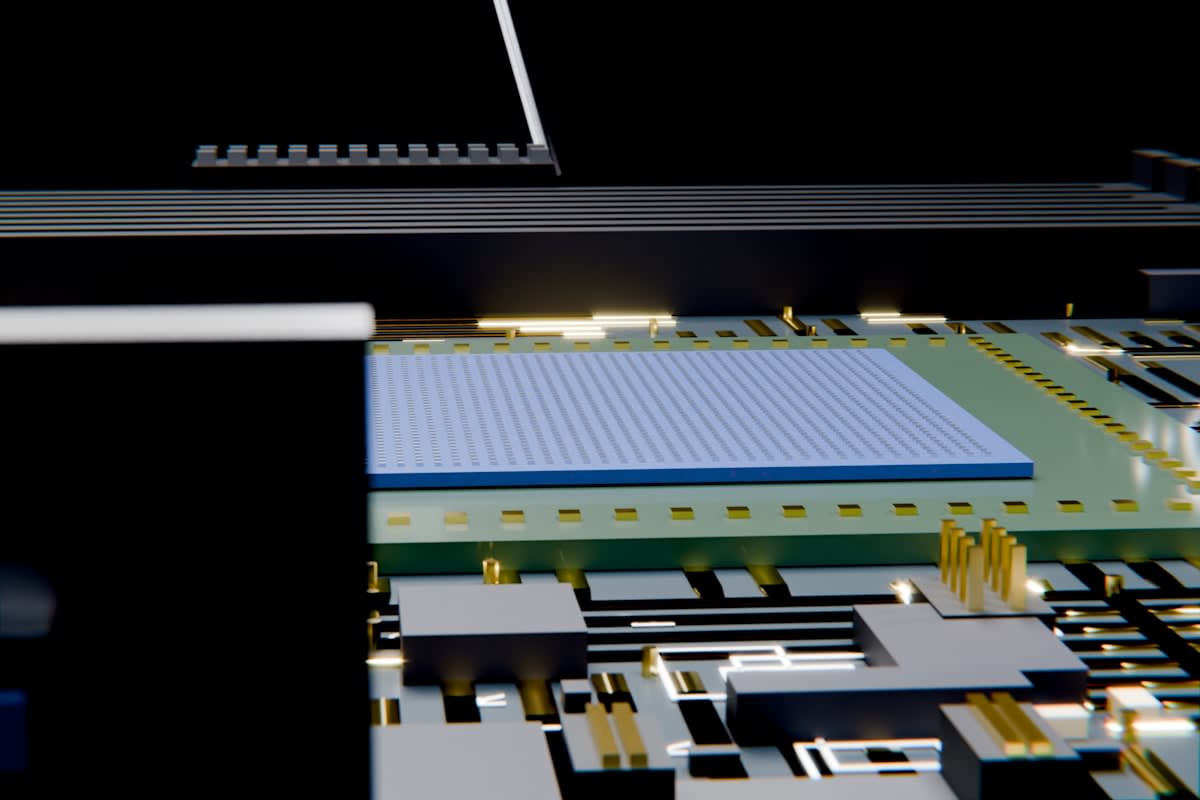
A new chip exists. Nature reports an all-transistor probabilistic computer designed for diffusion-like models. Such hardware matches GPU performance on image benchmarks. Energy consumption drops by 10,000 times per generated sample. Efficiency has finally overtaken raw scale. This breakthrough proves that probabilistic architectures can handle complex generative tasks without the massive power draw of traditional tensors.
"Devices based on our architecture could achieve performance parity with GPUs on a simple image benchmark using ~10,000 times less energy."— Nature, July 2026
| Metric | GPU Standard | Probabilistic Hardware |
|---|---|---|
| Energy Consumption | High (Baseline) | 10,000x Lower |
| Task Focus | General Purpose | Diffusion/Probabilistic |
| Physical Basis | Deterministic Silicon | All-Transistor Random Bits |
Traditional silicon is too rigid. Deterministic logic wastes energy on precision that generative AI does not actually need. Probabilistic chips embrace randomness at the transistor level. This approach mimics the stochastic nature of the brain. It eliminates the need for the massive power-heavy matrix multiplications that keep GPU vendors wealthy.
Custom Silicon Sovereignty
Big AI is fleeing general GPUs. Anthropic is currently co-developing custom silicon with Samsung. Their goal is a purpose-built inference chip optimized for the Claude model family. This represents a move toward transistor-level precision. General-purpose hardware is now a liability. Custom silicon allows them to strip away the overhead of generic computation to maximize tokens per watt.
The Moat is the Metal
Anthropic is not shopping for a better GPU deal; it is engineering a purpose-built inference chip designed around the architecture of its Claude model family.
Custom silicon is a declaration of war. Anthropic is not looking for a vendor; they are building a moat. They are engineering this moat at the transistor level. This strategy ensures their models run with maximum efficiency. Samsung provides the fabrication capability to realize this vision. Control over the hardware stack is the only way to survive the coming energy crunch.
The Biological Leap
Biology is the ultimate compute. Nature describes the emergence of Organoid Intelligence (OI) using lab-grown brain cellular structures. These living neural organoids possess electrical activity and primitive learning. Computation is moving from silicon to biological substrates. This is the final frontier of energy efficiency. Biohybrid computers will likely dwarf neuromorphic chips in their ability to process parallel information.

Computing has moved through several distinct eras. Symbolic logic systems gave way to artificial neural networks. Neuromorphic processors then attempted to mimic biological neurons. Now, Organoid Intelligence (OI) incorporates actual living neural structures. This trajectory suggests that silicon may eventually be an interim technology. Biological substrates offer a level of flexibility that transistors cannot match.
Medical integration is accelerating this transition. Lee Marten, a Canadian ALS patient, recently received a Neuralink implant via an experimental surgical robot. This hardware places electrode threads directly through the dura. Such interfaces prove that biological-digital signaling is no longer theoretical. Real-world deployment is happening now.
Geopolitical Fallout
Global disparities are widening. A power outage in Lagos renders high-end GPU clusters useless, while Hsinchu grapples with the physical limits of chip fabrication. Asia is splitting into winners and losers based on this energy-compute iron triangle. Access to electrical power is now the primary gatekeeper of intelligence. Geopolitics is now a game of megawatts and nanometers.
Computing power is not an isolated metric. NiuNiu highlights an iron triangle consisting of computing, transport, and storage power. Electricity serves as the physical foundation for this entire network. Without stable power, the fastest chip is just an expensive paperweight. This reality forces a rethink of where data centers are located.
Projected AI Data Center Energy Consumption (US % of Total Energy)
Executive Insight
+18.4%
YTD Growth
The Second-Order Effect
The delta from last year is staggering. Twelve months ago, the industry accepted that AI growth required a linear increase in power plants. Current data from Nature suggests a 10,000-fold efficiency gain is possible. This fundamentally changes the investment thesis for the next decade. We are moving from a regime of brute force to one of architectural elegance.
GPU monopolies are built on the assumption of energy abundance. Their dominance vanishes when a single probabilistic chip can outperform a cluster at a fraction of the cost. New winners will emerge from the bio-silicon intersection. Every company clinging to general-purpose GPU scaling is gambling against physics. The energy monopoly is dead.