
AI Executive Summary
"This article analyzes the systemic shift toward patient autonomy driven by AI and wearable bio-hardware. It highlights the strategic necessity for providers to adapt to a 'Hospital-at-Home' model to prevent patient attrition and improve outcomes."
The End of the Waiting Room?
The traditional medical appointment is becoming a secondary event. This week, data from the ZS Impact Institute reveals a systemic breakdown in how patients seek care globally. We are seeing a patient-led rebellion driven by sheer frustration. 58% of U.S. patients now research symptoms before they even consider booking an appointment. This isn't a subtle shift; it is a wholesale migration of the diagnostic process from the clinic to the smartphone.
The catalyst is not just the availability of technology, but a collapse in trust and access. 45% of U.S. patients avoid seeing a physician until they are already sick. Even more alarming? 41% have not had a health check-up in three years or more. When the system fails to provide timely access, patients turn to AI. Currently, 18% of patients are utilizing AI to navigate their health, while 94% of those using search engines find the information helpful.
The Friction Gap
The friction is palpable: 36% of patients wait a year or more for a diagnosis, and 54% stop their prescribed treatments prematurely. The system is leaking patients because it cannot keep pace with the consumer's need for immediacy.
While the U.S. battles institutional inertia, the hardware of healthcare is becoming invisible and ubiquitous, moving from bulky machines to the skin itself.
Invisible Guardians and Digital Twins
The frontier of monitoring has moved beyond the smartwatch. Recent research published in Nature introduces a low-cost, ultra-thin microwave tattoo sensor. Operating across a wide bandwidth of 2.4 to 17 GHz, this transparent skin-patch monitors respiratory patterns. The immediate ripple effect? Non-invasive, continuous monitoring for epilepsy-related apnea or irregular breathing without the patient ever feeling the device.

But hardware is only half the battle. To make 'Hospital-at-Home' (HaH) viable, we need resilience against system failures. Nature has proposed a digital-twin-based framework—personalized models updated in real-time. These digital twins act as a safety net, allowing clinical management to continue even during network outages or cyberattacks. It transforms the home into a 'virtual ward' that doesn't crash when the Wi-Fi does.
This convergence of invisible sensing and digital redundancy is moving the locus of care from centralized hospitals in cities like Tokyo or New York to the living rooms of the suburbs and rural outposts.
The Architecture of Autonomy
We are seeing a new model of care that prioritizes autonomy over physician-led directives. In the Imperial Valley, the Program of All-Inclusive Care for the Elderly (PACE) by Innercare is operationalizing this. It is a system where seniors—those 55 and older who qualify for nursing home care—remain in their community and stay in charge of their own healthcare, supported by a multidisciplinary team rather than being at the mercy of a single doctor.
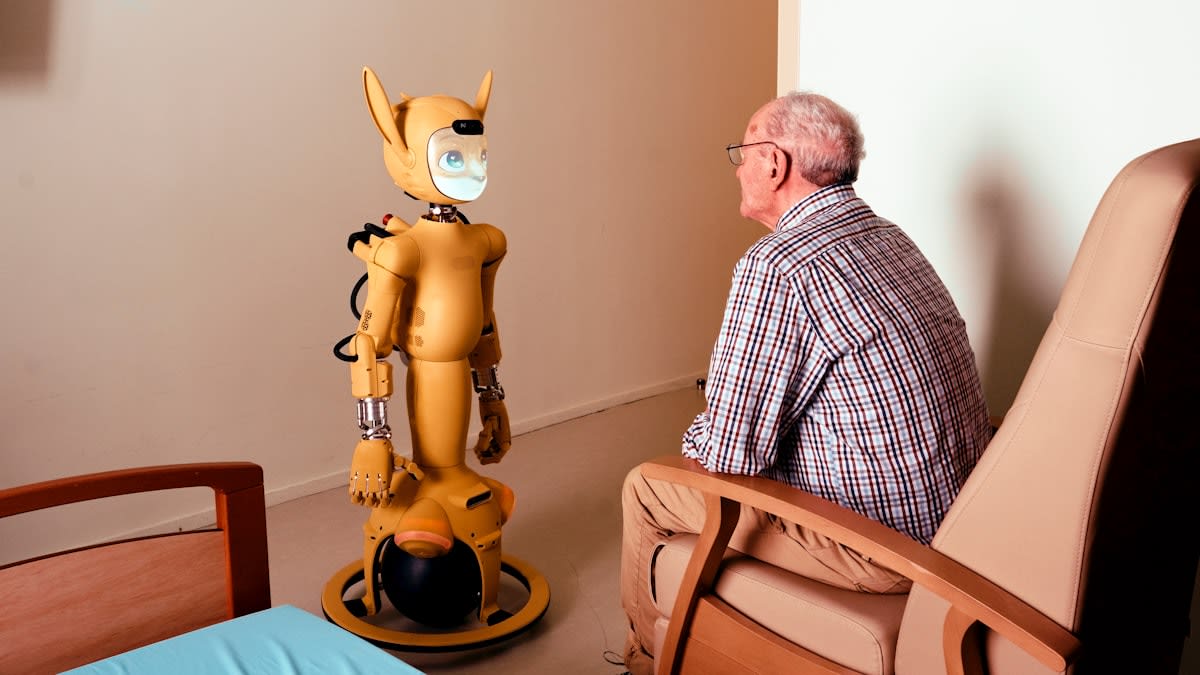
For the most vulnerable, the 'digital human' is the next line of defense. Texas A&M University Health is developing AI-powered digital humans to spot early dementia indicators, like apathy, before cognitive decline is even measurable. Simultaneously, the University of New Hampshire is deploying socially assistive robots into real homes to solve the caregiver shortage.
| Metric | Traditional Model | Emergent Trend |
|---|---|---|
| Diagnostic Trigger | Physician Appointment | AI/Symptom Research (58%) |
| Monitoring Method | Periodic Clinic Visits | Continuous Tattoo Sensors |
| Care Location | Centralized Hospital | Virtual Wards / Digital Twins |
| Dementia Detection | Cognitive Testing | AI Digital Human Indicators |
The reality is stark: the healthcare industry is no longer the sole gatekeeper of medical knowledge. Between the 18% already using AI for decisions and the rise of unobtrusive sensors, the power has shifted. The winners will be the providers who stop fighting the 'self-diagnosing patient' and instead build systems that support this new, autonomous reality.