
AI Executive Summary
"This article analyzes the systemic shift from centralized medical laboratories to a distributed 'scan-and-solve' model. It highlights the intersection of high-compute hardware and global health equity, providing a strategic roadmap for the future of diagnostic delivery."
The diagnostic bottleneck is finally breaking. For decades, the clinical gold standard relied on a centralized loop: a patient provides a sample, a courier transports it to a distant lab, and a technician processes it days later. This latency is no longer acceptable in a world where compute power has caught up with biological complexity. We are witnessing a violent shift toward Point-of-Care (PoC) testing, where the distance between the sample and the result is reduced to zero. This is not a gradual evolution; it is a systemic displacement of the laboratory as the primary site of medical truth.
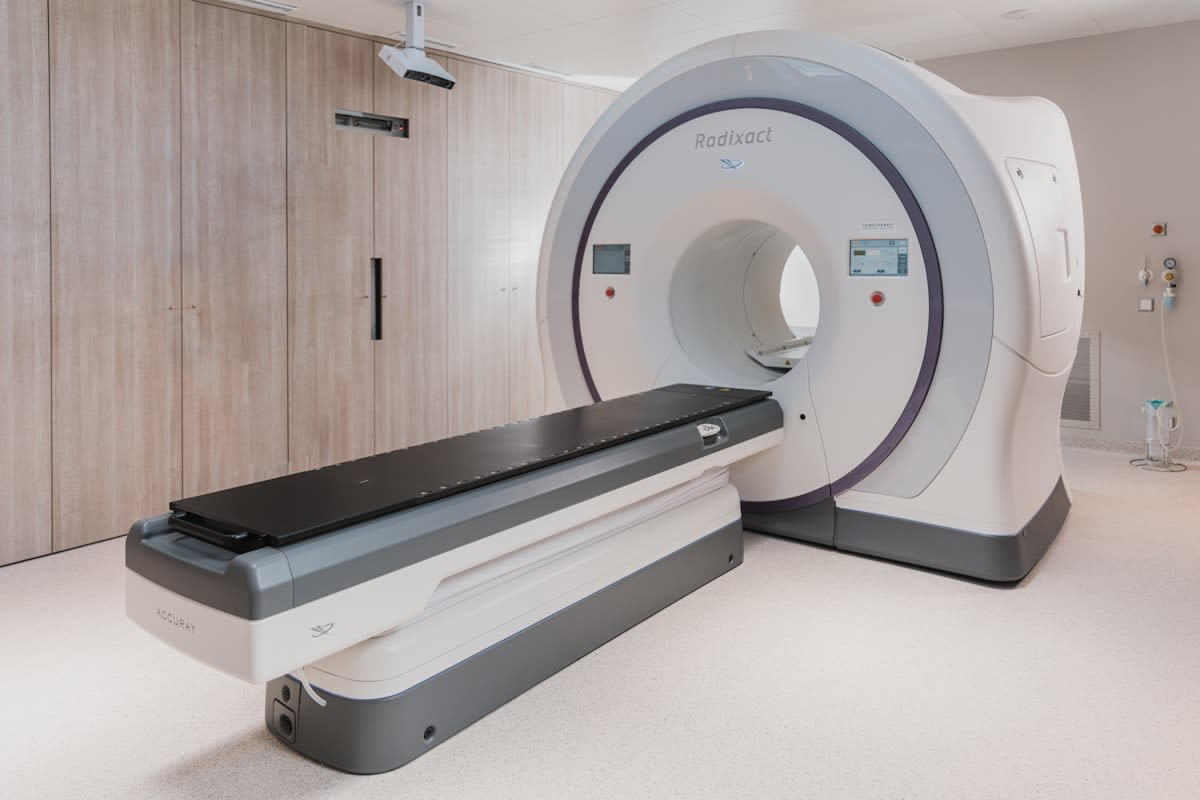
The most aggressive signal of this shift arrived on June 18, 2026, when Midjourney Medical unveiled its prototype full-body ultrasound scanner. This is not a handheld device for a clinic; it is a water-immersion system that leverages a massive $74 million licensing deal with Butterfly Network to bring Ultrasound-on-Chip technology to an industrial scale. By submerging a user in a shallow pool and passing them through a ring of half a million ultrasonic sensors, the system produces a 3D body scan in approximately 60 seconds. The 'so what' is immediate: we are approaching MRI-level detail at a fraction of the time and cost, effectively moving high-fidelity imaging out of the radiology basement and into the immediate clinical path.
The Compute Layer: Petaflops vs. Pathology
What makes the Midjourney scanner a trend-setter rather than a gimmick is the underlying hardware-data co-design. The system utilizes roughly 2 petaflops of compute to handle the massive data volumes generated per scan, allowing for distributed real-time reconstruction. This represents a fundamental pivot in medical engineering: the hardware is no longer just a sensor, but a compute engine. While the company is launching with non-diagnostic body-composition maps to navigate the phased regulatory path of the FDA, the trajectory is clear. When diagnostic-grade 3D scans take one minute instead of one hour, the entire triage process of a hospital is rewritten.
The Compute Edge
The shift to PoC is not just about speed; it is about the democratization of high-fidelity data. When 2 petaflops of compute can replace a traditional MRI's time-cost, the geographic barrier to advanced diagnostics vanishes.
This technological surge is not confined to high-budget labs in the West. In East Africa, a parallel decentralization is occurring through the training of a new generation of surgeons and the growth of digital pharmacy chains. The goal is to remove the urban center as the sole provider of specialized care. By empowering local practitioners with better tools and training, the region is bypassing the 'centralized hub' phase of healthcare development entirely, moving straight to a distributed network of care. This structural leapfrogging mirrors the mobile banking revolution, where the infrastructure is the network itself, not a physical building.
The Nuance of Self-Testing in Epidemic Zones
However, decentralization is not a magic bullet. A recent modeling study published in Diagnostics provides a critical reality check on the role of self-testing in Africa. Researchers used a deterministic SEIR model to analyze priority pathogens, including Ebola, Influenza A, Cholera, Coronavirus, and Mpox. The findings were sobering: untargeted population-wide self-testing produced only a modest reduction in peak disease prevalence, averaging just 1.9%. This suggests that simply distributing test kits is not the same as controlling a transmission wave. The kit is a tool, not the intervention itself.
Yet, the study uncovered a vital nuance that changes the value proposition of PoC testing. While self-testing fails to 'flatten the curve' significantly, it is disproportionately effective at reducing total deaths, particularly for high-mortality pathogens with moderate transmission. The value of the test is not in the epidemiological data it provides to the state, but in the immediate, life-saving action it triggers for the individual. This shifts the objective of PoC testing from 'population surveillance' to 'individual survival,' a distinction that should redefine how policymakers allocate resources.
| Metric | Centralized Lab Model | Point-of-Care (PoC) Model |
|---|---|---|
| Turnaround Time | Days to Weeks | Seconds to Minutes |
| Primary Goal | Population Surveillance | Individual Intervention |
| Infrastructure | Fixed Hubs | Distributed Network |
| Data Volume | Sample-based | High-Compute/Sensor-based |
The ripple effects of this decentralization are appearing in unexpected places, including the pharmaceutical landscape of England. Data published in Nature Health on June 15, 2026, reveals a significant shift in primary care dispensing. The incident rate of central nervous system (CNS) medicines dropped from 6.0 per 1,000 person-months in February 2020 to 4.1 per 1,000 person-months in February 2024. This analysis of 52.6 million patients and 5.8 billion medications suggests a move away from the pandemic-era prescription spikes. It indicates a maturing approach to primary care where the immediate, reflexive prescription is being replaced by more targeted, perhaps more diagnostic-led, interventions.

Additive Manufacturing and the Physical Shift
The shift is not only in how we diagnose, but in how we treat. The market for titanium powder for medical applications is projected to expand at a compound annual growth rate (CAGR) of 8-12% between 2026 and 2035. This growth is driven by the accelerating adoption of additive manufacturing for orthopedic and dental implants. When surgical instruments and implants can be customized and printed closer to the point of care, the logistical reliance on centralized medical manufacturing hubs evaporates. We are moving toward a future where the 'lab' is a 3D printer and a high-compute scanner located in a regional clinic.
"Distributing test kits is not the same as controlling transmission... self-testing may be more valuable for reducing deaths than for flattening epidemic peaks."— Diagnostics Study, African Union Pathogen Analysis
The overarching trend is the collapse of the 'middleman' in healthcare. Whether it is the 60-second 3D scan from Midjourney, the self-test kit in a rural African village, or the 3D-printed titanium implant, the objective is the same: eliminate the lag. The centralized lab is not disappearing, but its role is being downgraded. It will remain the site of complex, rare-disease sequencing, but the daily business of diagnostics is moving to the edge. The era of the waiting room is ending because the answer is now available at the moment of the question.