
AI Executive Summary
"This article analyzes the emergence of the 'Human Premium,' arguing that as frontier models commoditize perfection, strategic value shifts toward provable human provenance and lived experience. It provides a framework for leaders to pivot from competing on algorithmic precision to competing on authentic human presence."
The Paradox of the Invisible Watermark
Consider the recent curiosity surrounding the new Air Force One, a vessel gifted by the government of Qatar. When White House Press Secretary Karoline Leavitt shared imagery of the aircraft, the discourse shifted instantly from the luxury of the gift to the authenticity of the pixels. The presence of fake books and an AI-generated eagle sparked a frantic search for the truth. Google has developed an invisible watermark to identify AI-generated content, yet this technical solution creates a psychological vacuum. When the watermark is absent, does that prove humanity, or does it simply prove the use of a different, more sophisticated generator? This tension reveals a systemic shift: we no longer trust the image; we trust the provenance.
Why does a fake book on a presidential plane matter? It matters because the 'perfect' image is now viewed with suspicion. In a world where AI can render a flawless library or a majestic bird of prey, the absence of error becomes a red flag. We are witnessing the birth of a new cognitive filter where the 'glitch' is the only remaining evidence of reality. The strategic analyst sees this not as a crisis of misinformation, but as the devaluation of the polished. When perfection is cheap and automated, the premium shifts to the erratic, the unplanned, and the provably physical.
This search for authenticity extends far beyond political optics and into the very fabric of our intellectual output. The literary world is currently grappling with the 'bombastic register'—a style of writing that is simultaneously characteristic of high-flown human prose and the over-confident output of Large Language Models. If a writer can fool an AI detector by simply being bombastic, the detector is not measuring intelligence, but a pattern of confidence. This creates a recursive loop where humans begin to write like AI to hide from AI, or conversely, lean into deep, messy idiosyncrasies to prove their existence.
The Guardian recently highlighted how novelists like Jennifer Egan and Jeanette Winterson are reflecting on this boundary. The central question is no longer whether AI can write a novel, but whether the reader will care if the 'ghost' in the machine is absent. The value of a book is not merely the sequence of words, but the knowledge that those words were forged in the crucible of human experience. When we pay for a novel, we are paying for the author's struggle, their specific trauma, and their unique cognitive biases. AI mimics the result, but it cannot simulate the process of living.
"These 'tells' are also characteristic of human writing, which, after all, the large language models (LLMs) that produce them were trained on."— Linguistic analysis via The Guardian
This blurring of lines forces us to ask: what happens when the mimicry becomes indistinguishable from the original? The answer lies in the shift from the 'what' to the 'who.' The Human Premium is the extra value assigned to a product because a human suffered or labored to create it. It is the difference between a digitally rendered diamond and one pulled from the earth; the physical cost is the point. In the realm of fiction, the 'bombastic' style is a tool, but the intention behind the style is the asset.
This obsession with the boundary between the organic and the synthetic is not limited to the page; it has migrated to the very skin we inhabit.
The Body as a Surface: Aesthetics of the Artificial
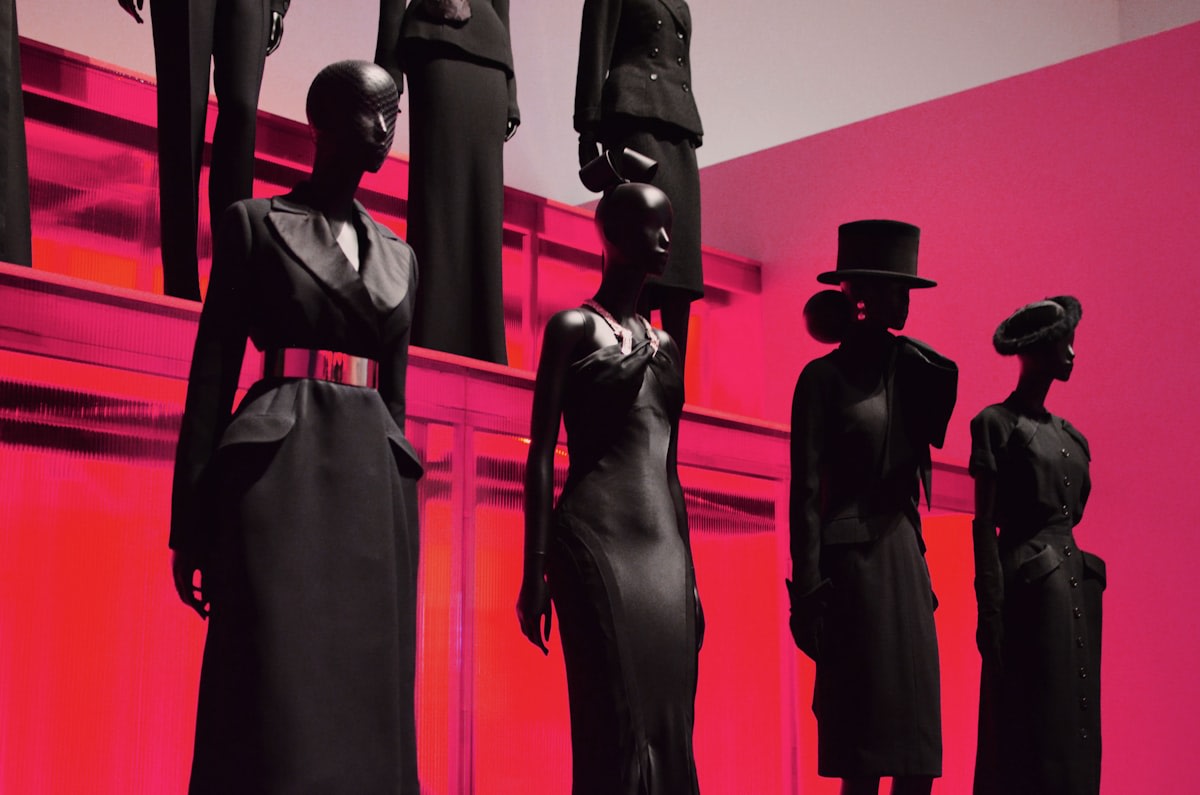
At the Polimoda Graduate Show 2026 in Florence, Emilie Wenckstern presented a collection titled 'No longer human.' The work serves as a visceral interrogation of the body in the digital age. Wenckstern asks a fundamental question: if a body can be generated, modified, and constructed before it even physically exists, what remains of the human? By using references to dolls, mannequins, and digital avatars, the collection transforms the body into a surface—a designed image rather than a biological entity. This is the physical manifestation of the AI dilemma.
Wenckstern's exploration suggests that as identity becomes constructed, the 'real' body becomes a luxury. When skin is treated as a surface to be designed, the biological imperfection—the scar, the asymmetry, the aging process—becomes the ultimate signifier of status. We are moving toward an era where 'perfect' beauty is the default setting of the masses, and 'natural' imperfection is the curated luxury of the elite. The boundary between the human and the artificial is not a wall, but a permeable membrane.
This shift in aesthetic value mirrors a broader economic trend. If the body can be a construction, then the only thing with inherent value is that which cannot be constructed: the lived experience. Wenckstern's work does not just question what a body is, but when it ceases to be one. This is the core of the Human Premium. The value is found in the transition—the moment where the design fails and the human emerges.
While the arts and aesthetics signal this shift, the systemic application of the Human Premium is already appearing in the world's emerging economies.
Systemic Resilience: The Digital-Human Hybrid
In Oman, the transition toward a post-oil economy is being driven by 'Oman Vision 2040.' The strategy leverages fintech not as a mere trend, but as essential infrastructure for a diversified economy. The Central Bank of Oman has implemented regulatory sandboxes and innovation programs to accelerate digital payments. On the surface, this is a story of digital efficiency. However, the IMF notes that digital transformation is a pillar for productivity and inclusivity. The critical insight here is that the technology is the skeleton, but the human institutional framework is the muscle.
A similar dynamic is playing out in the agricultural heartlands of Vietnam. In Dong Nai City, the Farmers' Associations are not simply handing out tablets; they are building human networks. The association has maintained 28 Zalo groups to connect commune-level leadership with 26 grassroots chapters. They have established a Farmers' Digital Transformation Club with 26 members. The digital tool (Zalo) is secondary to the social trust and the collective movement of the farmers. The technology facilitates the connection, but the value is generated by the human association.
| Sector | Algorithmic Baseline (The Commodity) | Human Premium (The Value Driver) | Key Indicator |
|---|---|---|---|
| Literature | Pattern-based prose/mimicry | Lived experience & authorial intent | The 'Bombastic' Register |
| Aesthetics | Symmetrical, designed avatars | Biological imperfection & asymmetry | Wenckstern's 'No longer human' |
| Agriculture | Data-driven yield optimization | Grassroots trust & communal coordination | Zalo-based Farmer Networks |
| Governance | Automated fintech infrastructure | Strategic leadership & inclusive policy | Oman Vision 2040 |
This pattern is repeated across Asia, where the Asian Management Excellence Awards 2027 are recognizing leaders who can navigate digital disruption. The awards do not celebrate the most automated companies, but those that have strengthened business resilience and fostered innovation. The 'so what' is clear: the competitive advantage in 2027 is not the ability to implement AI, but the ability to manage the human elements that AI cannot touch. Strategic execution remains a human prerogative.
The Contrarian Thesis
The strategic pivot is simple: Stop competing with AI on precision. Start competing on presence. The market is moving from valuing the 'Correct Answer' to valuing the 'Authentic Perspective.'
We are quietly paying more for imperfection because imperfection is the only remaining proof of life. Whether it is the subtle tells in a novel, the raw edges of a garment, or the messy coordination of a farmers' collective, these 'inefficiencies' are actually the highest form of value. In the economy of the future, the most expensive thing you can buy is something that was not optimized by an algorithm.
The Human Premium is not a nostalgic retreat into the past; it is a sophisticated adaptation to the future. By recognizing that perfection is now a commodity, leaders, artists, and policymakers can stop chasing the impossible standard of the machine and start investing in the irreplaceable nature of the human. The glitch is not a bug; it is the feature.