AI Executive Summary
"This article examines the transition from forklift-centric infrastructure to flexible bipedal robotics in dense logistics hubs. It highlights the strategic integration of bio-mimetic actuation and AI to optimize warehouse spatial economics and operational intelligence."
Warehouse floors are undergoing a quiet but violent reorganization. For decades, the forklift was the undisputed king of the loading dock, dictating everything from ceiling height to the width of the aisles. But in the last six months, the math has changed. Global logistics giants are no longer asking how to make their warehouses bigger to fit the machines; they are deploying machines that fit the warehouse. Bipedal robots, once the stuff of cinematic fiction, have moved out of the research labs and into active pilot programs where they are tackling the 'last ten feet' of the supply chain.
The immediate driver is a brutal reality of real estate costs. In high-density logistics corridors, such as the industrial belts of Tamil Nadu and Maharashtra in India, every square inch of warehouse floor is a premium asset. Traditional forklifts require massive turning radii and wide aisles to operate safely, effectively wasting 30% to 40% of potential storage space. Bipedal humanoids operate on a human footprint, allowing facilities to tighten their aisles and increase SKU density without sacrificing accessibility. This is not a gradual improvement; it is a total rewrite of spatial economics.
The 180-Day Delta
Six months ago, bipedal robots were largely showcase pieces used for PR stunts at tech conferences. Today, they are executing real-world 'pick-and-place' tasks in integrated pilots, moving from controlled lab environments to the chaos of live sorting centers.
The Infrastructure Trap
Forklifts created an infrastructure trap. To use them, companies had to build flat, reinforced concrete slabs and wide corridors, effectively locking themselves into a specific operational logic. If a company wanted to change its storage method, it often required a physical rebuild of the facility. Bipedal robots break this lock. Because they can navigate stairs, step over debris, and turn on a dime, they treat the existing warehouse as a flexible environment rather than a rigid constraint. They don't require the world to be rebuilt around them; they adapt to the world as it exists.
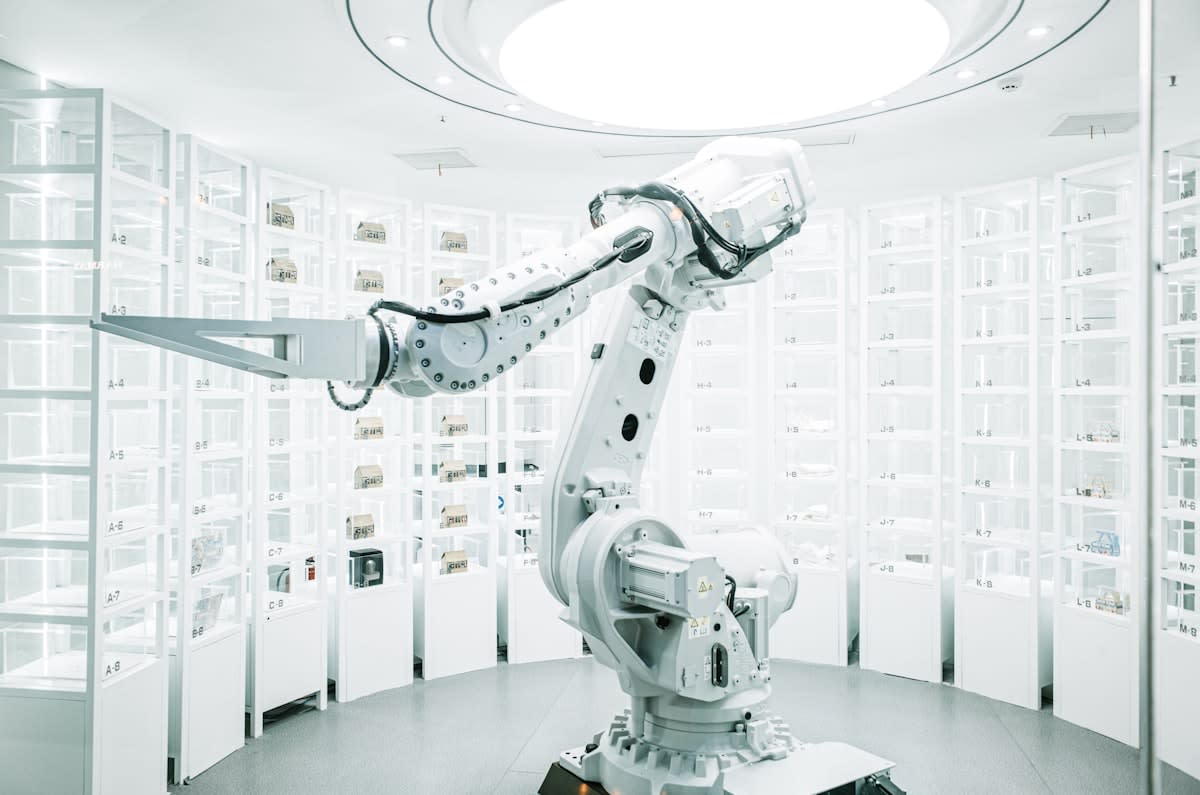
This flexibility is particularly critical in the Indian Subcontinent, where logistics hubs often struggle with legacy infrastructure and uneven flooring. In the massive distribution centers surrounding Mumbai, the ability of a bipedal unit to navigate a non-standardized environment is a massive competitive advantage. While a traditional Automated Guided Vehicle (AGV) would trigger a safety stop the moment it encountered a misplaced pallet or a slight grade change, bipedal systems use real-time balance adjustments to keep moving. This resilience reduces downtime and eliminates the need for expensive floor resurfacing projects.
| Metric | Traditional Forklift | Bipedal Humanoid |
|---|---|---|
| Aisle Width Requirement | 3.5m - 4.5m | 1.0m - 1.5m |
| Terrain Versatility | Flat Concrete Only | Stairs, Slopes, Debris |
| Onboarding Time | Weeks (Certification) | Hours (Software Sync) |
| Task Range | Pallet Movement Only | Multi-modal (Bins, Boxes, Pallets) |
But why now? The catalyst is the convergence of edge computing and large-scale multimodal models. A year ago, a robot needed a pre-programmed map to move a box from point A to point B. If the box was shifted three inches, the robot failed. Now, these machines use visual language models to 'understand' what a box is and how to grip it regardless of orientation. They are no longer following a script; they are perceiving the environment. This leap in cognitive dexterity allows them to handle the variety of packaging that makes forklift automation so difficult.
"The goal isn't to build a robot that acts like a machine, but a robot that acts like a versatile employee who never sleeps and doesn't require a wide turning radius."— Lead Robotics Engineer, Logistics Pilot
The financial argument is equally compelling. While the initial capital expenditure for a bipedal unit is higher than a mid-range forklift, the operational savings are found in the 'hidden' costs. Companies are seeing a reduction in workplace accidents, as humanoids don't suffer from operator fatigue or blind-spot errors. Furthermore, the ability to increase storage density by 30% without expanding the physical building footprint provides an immediate return on investment that dwarfs the cost of the hardware.
The Operational Realignment
We are witnessing a move toward 'dark warehouses' that don't actually look dark—they just look human. Instead of rearranging the world to fit the robot, the robot is mimicking the human form to fit the world. This allows for a hybrid workforce where humans and bipeds share the same space without the need for safety cages or segregated zones. The forklift, by contrast, is a dangerous intruder in a human space, requiring strict lanes and flashing lights to prevent fatalities.
Consider the impact on the global labor market. In regions where manual picking is the norm, the introduction of bipedal robots isn't just about replacing a driver; it's about replacing the physical toll of the job. The transition is moving faster than expected because the software is scaling globally. A robot trained in a facility in Tokyo can have its learned weights uploaded to a unit in Chennai in seconds. This creates a global intelligence network where every robot learns from the mistakes of every other robot in the fleet.
- Elimination of wide-aisle mandates, increasing storage density by up to 40%.
- Reduction in OSHA-style certification timelines from weeks to near-instant software deployment.
- Ability to utilize multi-level mezzanines and stairs, removing the need for expensive freight elevators.
- Integration of visual LLMs allowing for the handling of non-standardized packaging.
The final hurdle is no longer the hardware; it is the trust. Logistics managers are cautious about relying on a bipedal system for 24/7 operations. However, the data from early 2024 pilots suggests that uptime is stabilizing. As these machines move from 'experimental' to 'essential,' the forklift will be relegated to the same status as the horse-drawn carriage: a tool that was once indispensable but became an obstacle to efficiency.
The bottom line is that the physical architecture of global trade is being rewritten. The transition to bipedal robotics is not about the novelty of walking machines; it is about the liberation of space. When the machine fits the human world, the cost of moving goods drops, and the speed of delivery accelerates. The forklift didn't fail; it simply reached the limit of what a rigid machine can do in a fluid world.