AI Executive Summary
"This article provides a technical blueprint for deploying high-performance Edge AI in extreme tropical environments. It emphasizes the critical intersection of thermal engineering, low-TDP silicon, and local supply chain resilience to ensure industrial uptime."
Heat kills. Silicon melts when the ambient air hits 40 degrees Celsius in the heart of the city. Moisture seeps into every gap, turning solder joints into conductive crusts of corrosion. This environment destroys standard server racks within months. Only sealed, industrial-grade hardware survives the humidity of Ho Chi Minh City.
Solar arrays provide the necessary juice for these remote nodes. TotalEnergies ENEOS delivered a 28 MWp system to the Samsung Electronics HCMC CE Complex on July 3, 2026. Powering edge nodes requires this kind of scale to avoid brownout cycles. Voltage drops are common in industrial zones. Reliable energy prevents the sudden hard-reboots that corrupt flash storage in high-density compute environments.
Johor is the new logistics hub for this hardware. Vertiv opened its manufacturing facility there on July 2, 2026, to accelerate the delivery of thermal management solutions. These units handle high-density computing loads that would otherwise throttle in minutes. Thermal saturation occurs when the internal case temperature exceeds the T-junction limit of the CPU. Effective heat sinking is the only way to maintain clock speeds.
Silicon efficiency matters more than raw clock speed. Avalue utilizes Intel Core Ultra and Panther Lake processors to keep wattage low. Lower power means less heat to evacuate from a sealed box. Edge AI demands high performance, but the physics of a closed IP67 enclosure limit the thermal envelope. Balancing these two is the hardest part of the build.
The Humidity Tax
When deploying in HCMC, ignore the theoretical MTBF provided by vendors. Humidity and salt air accelerate chemical degradation of capacitors. Assume a 30% reduction in component lifespan unless the enclosure is truly hermetic.
Imports are a liability for maintenance. The Investment and Trade Promotion Centre of HCM City (ITPC) and the Ho Chi Minh City Supporting Industry Association (HASI) met on July 2, 2026, to discuss localizing the supply chain. Localizing production reduces the lead time for replacement gaskets and seals. Manufacturing capacity must grow within the city to support these deployments. Vietnam cannot rely on external inputs for critical hardware during a failure event.
China is scaling its infrastructure at a pace that dwarfs regional neighbors. Market analysis from IndexBox shows unit demand for IT rack systems doubling between 2026 and 2035. This growth is fueled by 5G/6G and energy storage. Vietnam can learn from this scale to lower the cost of sealed enclosures. Mass production of standardized racks reduces the cost of custom IP67 modifications.
Hardware Prerequisites
- IP67-rated aluminum chassis with passive heat-sink fins
- Avalue Industrial PC with Intel Panther Lake (low TDP)
- Vertiv thermal management interface for high-density loads
- Industrial-grade gaskets rated for 95% non-condensing humidity
- DC-DC converters capable of handling solar-input voltage swings
Deployment Sequence
- Select a chassis with a thermal conductivity rating that matches the expected TDP of the Avalue compute module.
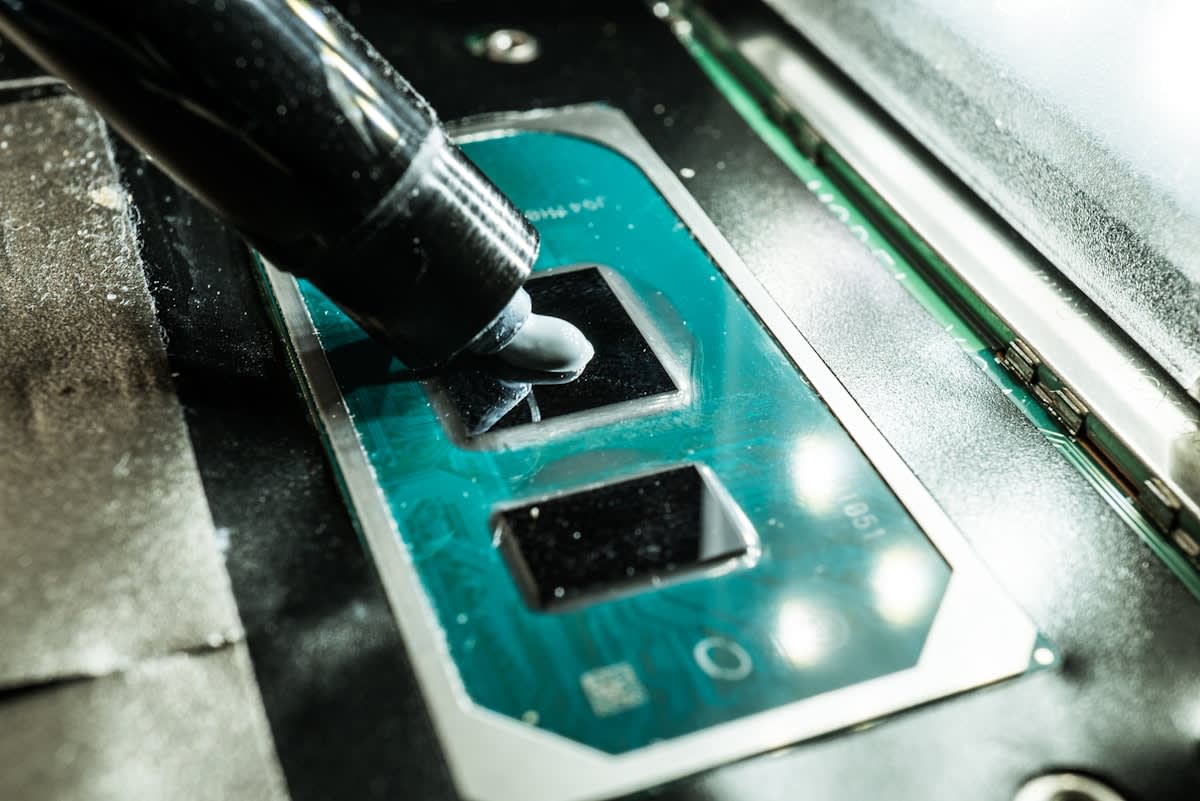
- Install the Intel Core Ultra processor, ensuring the thermal paste is applied in a thin, even layer to avoid air pockets.
- Mount the internal components using vibration-dampening standoffs to prevent mechanical fatigue from industrial machinery.
- Integrate Vertiv cooling solutions, focusing on the interface between the CPU heat spreader and the external enclosure wall.
- Seal the enclosure using high-grade industrial gaskets, verifying the IP67 seal with a vacuum pressure test.
- Connect the node to the local power grid or a rooftop solar system, such as the 28 MWp infrastructure seen at the Samsung HCMC complex.
Thermal Management Logic
Passive cooling is the only reliable method in dust-heavy zones. Fans fail when grit clogs the bearings. Heat must move from the silicon to the chassis via conduction. This requires a direct metal-to-metal path. Using a thermal bridge allows the entire IP67 box to act as a radiator.
Internal air pockets act as insulators. These pockets trap heat and create hotspots on the motherboard. Thermal pads must fill every millimeter of gap between the PCB and the aluminum wall. This ensures that heat is distributed evenly across the surface area. Failure to do this leads to localized overheating and premature chip failure.
| Component | Standard Hardware | HCMC Hardened Spec |
|---|---|---|
| Processor | Standard Intel Core | Intel Panther Lake (Low TDP) |
| Enclosure | Perforated Steel | Sealed IP67 Aluminum |
| Cooling | Active Fans | Passive Conduction/Vertiv Thermal |
| Power Source | Grid Only | Hybrid Solar/Grid (28MWp Scale) |
Mechanical Failure Modes
Condensation is the silent killer. When the temperature drops rapidly at night, moisture forms inside the enclosure. This water settles on the circuitry and causes short circuits. Desiccant packs are a temporary fix. The only permanent solution is a hermetic seal combined with a controlled internal pressure.
Thermal throttling kills performance. CPUs will drop their clock speed to 800MHz to avoid melting. This renders Edge AI useless for real-time analysis. Monitoring the T-junction temperature is mandatory. If the delta between internal and external temperature exceeds 20 degrees, the system is failing.
Common Pitfalls
Over-tightening bolts warps the chassis. A warped frame creates a gap in the gasket. This allows humid air to enter the enclosure. Use a torque wrench to ensure a uniform seal. Small leaks lead to total system failure over time.
Ignoring the local supply chain creates downtime. Waiting for a part from Malaysia or China is a mistake. Work with HCMC-based associations like HASI to find local gasket manufacturers. Fast replacement of seals is the only way to maintain 99.9% uptime. Local sourcing is a technical necessity, not a corporate goal.