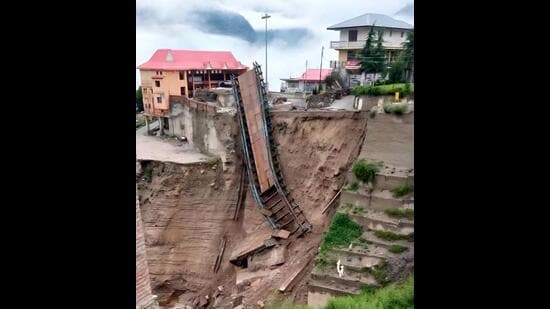
Kinnaur cut off after Sangla bailey bridge collapses into stream
Source Entity
Latest News: Today's Latest News Headlines from India & World | Hindustan Times | Hindustan Times
Intelligence Synthesis
AI-Generated Core Insights
Heavy monsoon rains in the Kinnaur district have caused the collapse of the Sangla bailey bridge, effectively isolating the region. The severe weather has also led to the submergence of homes in Lippa and necessitated emergency silt flushing on the Parbati river to manage dam levels, while weather forecasts predict continued downpours.
Crisis in the Himalayas: Kinnaur Isolated by Infrastructure Failure
The district of Kinnaur is currently facing a severe humanitarian and logistical crisis following the collapse of the Sangla bailey bridge into a surging stream. This critical failure has effectively severed the primary transport artery for the region, leaving local populations isolated and cutting off essential supply chains. The collapse is not an isolated incident but part of a broader pattern of monsoon-driven devastation that has seen heavy rains batter the fragile mountainous terrain of Himachal Pradesh, turning seasonal streams into destructive torrents.
The Strategic Failure of the Sangla Bailey Bridge
The loss of the Sangla bailey bridge is particularly significant due to the nature of the infrastructure. Bailey bridges are pre-fabricated, portable truss bridges often used as temporary measures or in remote areas where permanent construction is challenging. While efficient for rapid deployment, they are often more vulnerable to the extreme hydraulic pressure and scouring caused by flash floods. The collapse indicates that the stream's volume and velocity exceeded the structural tolerances of the bridge, highlighting a critical vulnerability in the region's transit network. For a remote area like Kinnaur, such a bridge is not merely a convenience but a lifeline for medical emergencies, food transport, and administrative access.
Cascading Environmental Impacts: Lippa and the Parbati River
Beyond the bridge collapse, the environmental devastation extends to the village of Lippa, where houses have been submerged by rising waters. This suggests a systemic failure of drainage and the overflowing of natural watercourses due to saturated soil. Simultaneously, the situation on the Parbati river has reached a critical threshold, prompting authorities to initiate dam silt flushing. Silt flushing is a necessary but risky operation used to remove accumulated sediment from reservoirs to maintain capacity and structural integrity during heavy inflows. However, the sudden release of silt-laden water into the river downstream can exacerbate flooding and erosion, creating a precarious balancing act for dam operators trying to prevent a total breach while minimizing downstream damage.
Geological Vulnerability and the Monsoon Cycle
To understand the severity of this event, one must consider the geological context of the Kinnaur region. Situated in the young, tectonically active Himalayas, the area is characterized by steep slopes and unstable soil. During the monsoon season, these factors combine to create a high risk of landslides and flash floods. The current weather warnings from the Meteorological (MeT) office regarding further downpours suggest that the region is in the midst of a prolonged atmospheric river event, where moisture-laden winds provide a continuous supply of rain, preventing the land from draining and increasing the likelihood of further infrastructure failures.
Socio-Economic Implications of Regional Isolation
Being "cut off" in the context of Kinnaur has profound socio-economic implications. The region is heavily dependent on the transport of agricultural produce, particularly apples, which are a cornerstone of the local economy. The collapse of the Sangla bridge disrupts the movement of goods to market and prevents the entry of essential supplies. Furthermore, the isolation poses a significant risk to public health; if medical emergencies arise in the cut-off zones, the lack of road access means that evacuation becomes nearly impossible without expensive and weather-dependent aerial support, potentially leading to avoidable loss of life.
Future Trends: Moving Toward Climate-Resilient Infrastructure
This disaster underscores an urgent need for a shift from temporary to climate-resilient infrastructure in high-altitude zones. The reliance on bailey bridges in the face of increasing weather volatility—likely exacerbated by global climate shifts leading to more intense monsoon bursts—is becoming unsustainable. Future urban and rural planning in Kinnaur must prioritize permanent, high-span bridges and reinforced embankments to withstand the projected increase in peak river flows. Until there is a systemic upgrade to the region's engineering standards, the cycle of collapse and temporary repair is likely to repeat with every severe monsoon season.
Summary
The collapse of the Sangla bailey bridge, coupled with flooding in Lippa and emergency measures on the Parbati river, paints a picture of a region under extreme environmental stress. The isolation of Kinnaur serves as a stark reminder of the fragility of mountain infrastructure and the immediate danger posed by intensifying weather patterns in the Himalayas.
Verification Required?