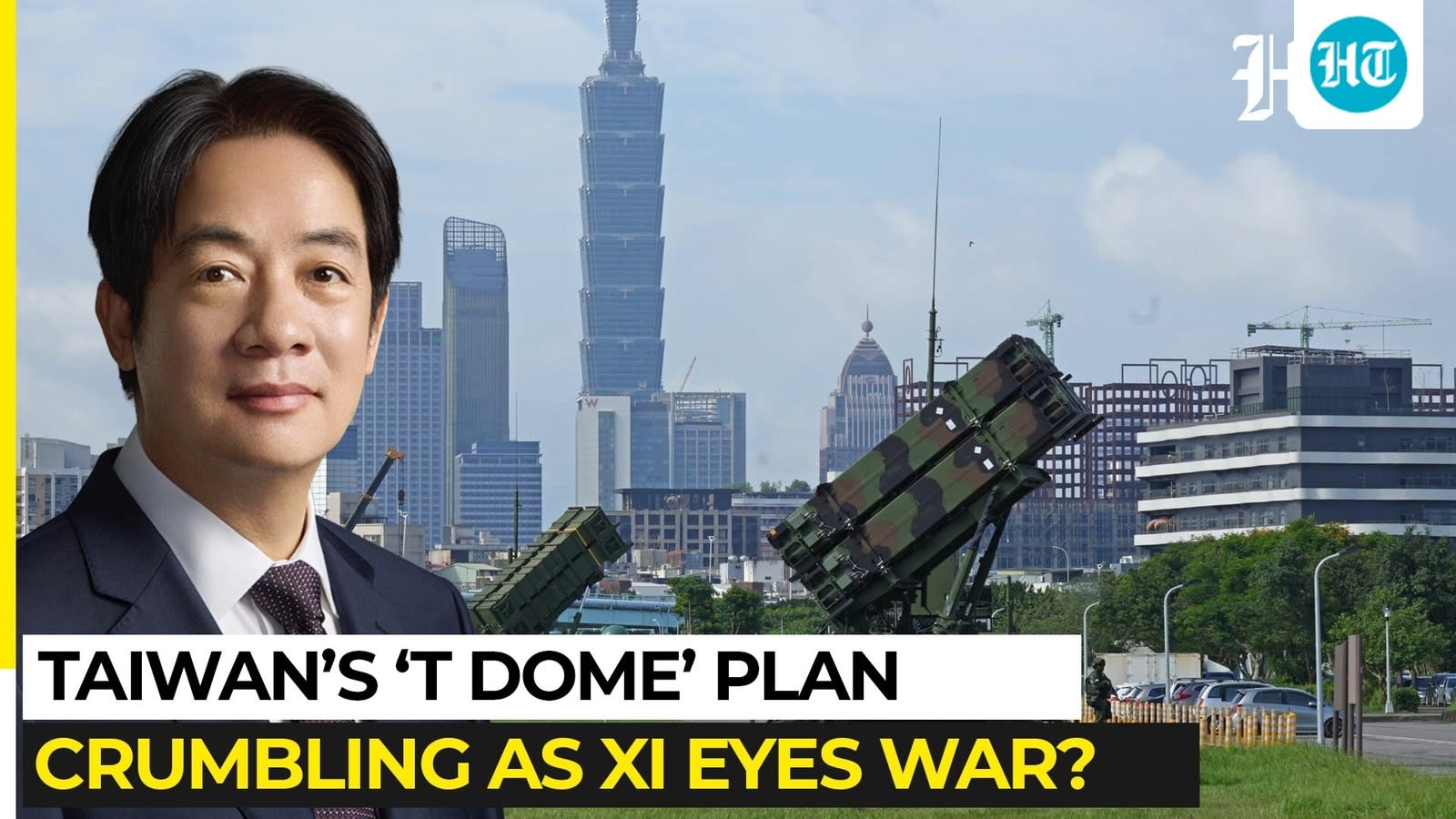
Trump’s Asian ally in danger? Taiwan’s ‘T-dome’ plan hits major roadblock as Xi prepares for war
Source Entity
Latest News: Today's Latest News Headlines from India & World | Hindustan Times | Hindustan Times
Intelligence Synthesis
AI-Generated Core Insights
Taiwan's ambitious 'T-Dome' air defense project is facing significant delays due to budget disputes surrounding the Strong Bow missile system, potentially creating critical vulnerabilities in the island's defenses as China increases military pressure.
Strategic Vulnerability: The T-Dome Roadblock
Taiwan is currently navigating one of the most precarious security environments in its modern history. The "T-Dome" project, envisioned as a comprehensive, layered air defense shield, represents Taipei's primary strategic effort to deter a potential invasion or missile barrage from the People's Republic of China (PRC). However, recent reports indicate that this critical security pillar has hit a significant roadblock. Budgetary disputes surrounding the funding of the Strong Bow missile system have introduced unexpected delays, creating a precarious gap in the island's defensive posture at a time when military tensions in the Taiwan Strait are at a fever pitch.
The T-Dome Architecture and the Strong Bow System
The T-Dome project is not merely a single weapon system but a sophisticated integration of various missile interceptors and radar networks designed to protect Taiwan's airspace from diverse threats, ranging from cruise missiles to ballistic projectiles. Central to this architecture is the Strong Bow missile system, a cornerstone of Taiwan's indigenous defense capability. By relying on domestic production, Taiwan aims to reduce its dependence on foreign suppliers—most notably the United States—ensuring a more sustainable and customizable defense perimeter. The current funding deadlock suggests a friction between the military's urgent operational requirements and the government's fiscal constraints or political priorities, potentially stalling the deployment of these critical interceptors.
Geopolitical Pressures and the Beijing Factor
This internal administrative struggle occurs against the backdrop of escalating aggression from Beijing. Under President Xi Jinping, the People's Liberation Army (PLA) has significantly increased its sorties across the median line of the Taiwan Strait and conducted large-scale encirclement exercises. The strategic intent is clear: to exhaust Taiwan's air force and test the responsiveness of its air defense systems. For Beijing, any delay in the completion of the T-Dome shield is a strategic windfall. A perceived weakness in Taiwan's layered defense could embolden the PRC to accelerate its timeline for "reunification," viewing the budget-induced gaps as an opportunity to achieve air superiority more rapidly during an initial strike.
Asymmetric Warfare and the 'Shield' Dilemma
In response to China's overwhelming numerical advantage, Taiwan has been pivoting toward an "asymmetric warfare" strategy. This approach emphasizes the use of mobile, lethal, and decentralized weapon systems to make an invasion prohibitively costly. However, asymmetric capabilities are most effective when they are supported by a robust defensive shield that protects critical infrastructure and command centers. If the T-Dome project remains stalled, the "shield" becomes the weak link in the strategy. While live-fire exercises continue to sharpen the skills of the personnel, the lack of physical hardware—specifically the Strong Bow systems—means that the military is training for a level of protection that may not actually exist in a real-world conflict.
The Friction of Democratic Governance
The budget disputes mentioned highlight a recurring challenge within Taiwan's democratic governance: the balance between necessary defense spending and socioeconomic stability. Allocating massive funds to the T-Dome project requires political consensus, which can be fragile during election cycles or periods of economic volatility. This internal struggle underscores the difficulty of maintaining a "war footing" in a peacetime economy. The delay in funding the Strong Bow system is likely a symptom of deeper debates over how to prioritize defense spending in an era of inflation and shifting global trade dynamics, yet these domestic debates are happening in a vacuum that ignores the accelerating military buildup across the strait.
Conclusion: A Race Against Time
Ultimately, the T-Dome project is a race against time. The ability of Taiwan to close the gaps in its air defense network is not just a matter of military procurement, but a critical signal of resolve to both its allies and its adversaries. If Taipei can resolve its budget disputes and expedite the deployment of the Strong Bow system, it can maintain a credible deterrent. However, if the roadblock persists, the strategic advantage will continue to shift toward Beijing. The intersection of fiscal policy and national security has become the new frontline in Taiwan's struggle for survival, making the resolution of these funding issues a matter of existential importance.
Verification Required?