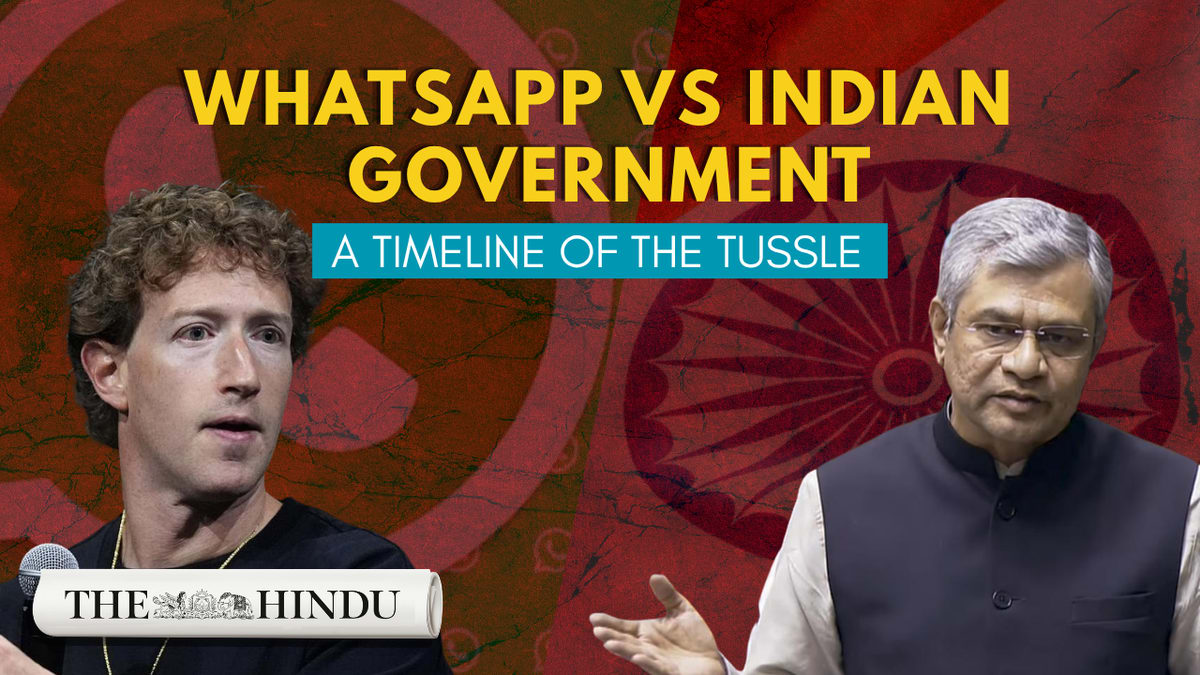
WhatsApp vs Indian Government: Why the battle has lasted over five years
Source Entity
India Latest News: Top National Headlines Today & Breaking News | The Hindu
Intelligence Synthesis
AI-Generated Core Insights
WhatsApp has filed a response to the Indian government's July 1 notice concerning its proposed username feature, the latest development in a protracted five-year regulatory and legal struggle over privacy, traceability, and state oversight.
The Digital Sovereignty Clash: WhatsApp vs. the Indian Government
The recent submission by WhatsApp in response to the Indian government's July 1 notice regarding a proposed 'username feature' is not an isolated regulatory hurdle, but rather a critical flashpoint in a systemic conflict. For over five years, the relationship between Meta's messaging giant and the Indian state has been characterized by a fundamental disagreement over where user privacy ends and national security begins. The introduction of usernames—which would allow users to communicate without sharing their phone numbers—has triggered alarms within the Centre, as it potentially complicates the government's ability to identify and track users during criminal investigations.
The Friction Point: Usernames and Traceability
At the heart of the current dispute is the concept of 'traceability.' For years, the Indian government has pushed for the ability to identify the 'first originator' of a message to combat misinformation and prevent the spread of illegal content. By moving toward a username-based system, WhatsApp is effectively adding a layer of abstraction between a user's real-world identity (tied to a SIM card and phone number) and their digital presence. From the government's perspective, this feature could be viewed as a mechanism to grant users anonymity, thereby undermining the mandates set forth in the Information Technology (Intermediary Guidelines and Digital Media Ethics Code) Rules, 2021.
Historical Context of the Five-Year Battle
To understand the gravity of the July 1 notice, one must look back at the broader legal trajectory starting around 2019. The battle has primarily centered on End-to-End Encryption (E2EE). WhatsApp has consistently maintained that breaking encryption to provide traceability would compromise the security of all users, not just the targets of investigation. This steadfast refusal has led to multiple court cases and regulatory threats. The government, conversely, argues that no platform should be a 'safe haven' for criminals or terrorists, asserting that the state must have the legal tools to intercept communications when judicial oversight is present.
Broader Implications for Global Tech Regulation
This confrontation serves as a bellwether for how global technology companies navigate 'digital sovereignty.' India, as one of WhatsApp's largest markets, represents a significant leverage point. If the Indian government successfully forces WhatsApp to modify its username feature or compromise its encryption, it could create a blueprint for other nations to demand similar concessions. This creates a precarious balancing act for Meta: maintaining a global standard of privacy to retain user trust while complying with local laws to avoid service disruptions or heavy penalties in a critical growth market.
Predicting Future Trends and Legal Outcomes
Looking ahead, the resolution of this specific dispute over usernames will likely be decided in the courts rather than through a simple administrative agreement. We can expect a protracted legal argument over whether a username feature constitutes a 'circumvention' of existing traceability laws. Furthermore, this may accelerate the trend of 'localized' app versions, where features are toggled on or off based on the jurisdiction of the user. The tension suggests that the era of a uniform, global internet experience is fading, replaced by a fragmented landscape governed by national borders and local regulatory regimes.
Conclusion: A Stalemate of Values
In summary, the clash over the username feature is a symptom of a deeper, ideological divide. On one side is the corporate commitment to user privacy and the technical integrity of encryption; on the other is the state's mandate to ensure law and order through digital surveillance. As WhatsApp continues to respond to the Centre's notices, the outcome will ultimately define the boundaries of digital anonymity in the world's largest democracy and set a precedent for the global tech industry.
Verification Required?